Real-time Communication
Slack Calls
How a hundred million remote workers got into and out of a call in the year the office disappeared.
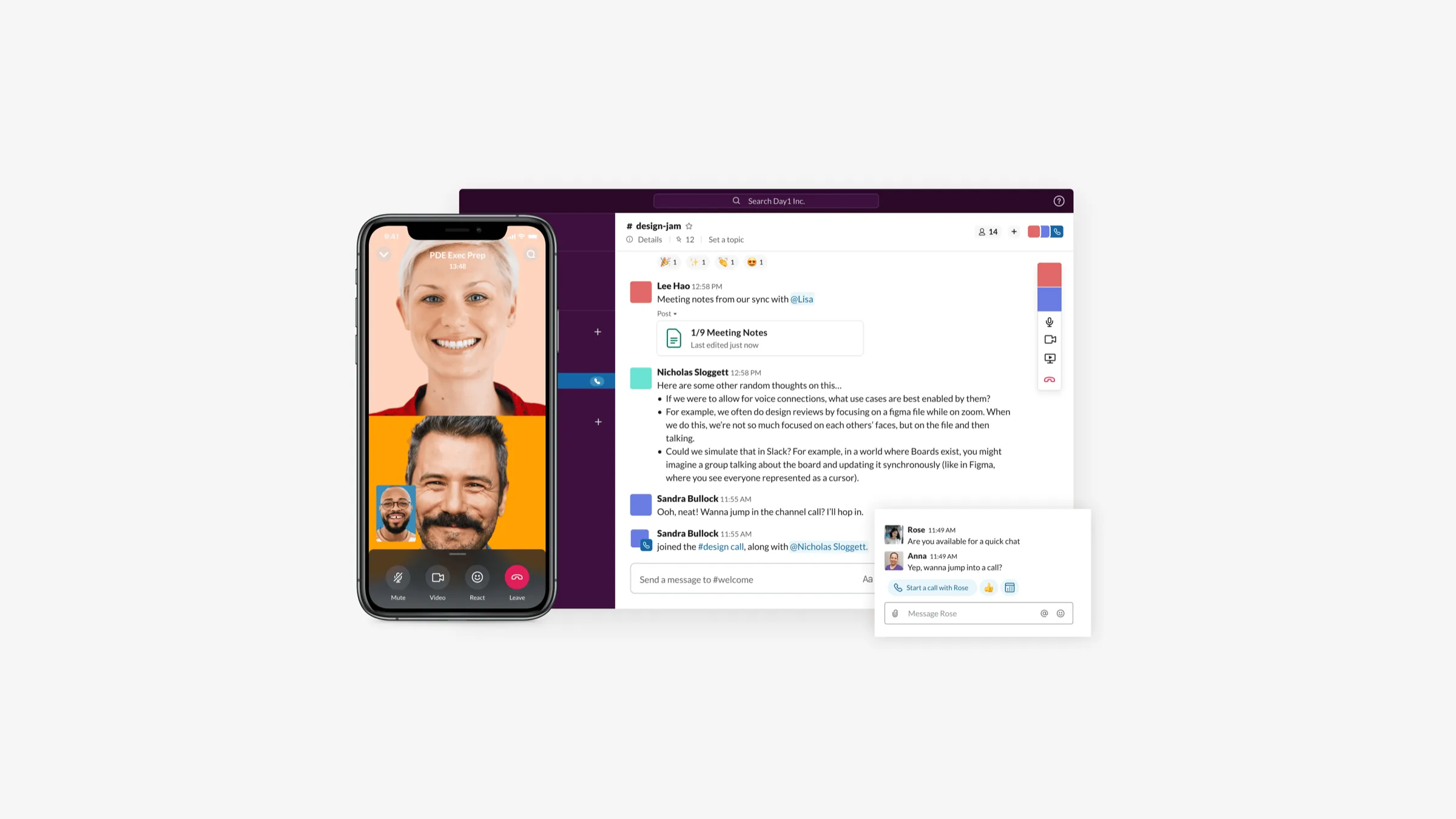
Slack Calls was built for a world where a call was the exception, a quick escalation out of a thread. In March 2020 that world ended and the same surfaces were suddenly carrying entire companies' workdays. I joined the Calls team on contract to make the joining, in-call, and screen-share experiences hold under that load.
Make the existing system hold
The mandate wasn't to reinvent. Usage was climbing past anything the original designs had assumed, and the job was to keep the system standing: reduce the friction of getting in, keep people oriented once inside, and make screen sharing feel like showing a colleague your monitor rather than operating an A/V rig.
Joining is the product
Most of a call's failure modes happen in the first ten seconds. Wrong mic. Wrong output. Joining muted when you meant to talk, or loud when you meant to lurk. We reworked the join flow so state was visible and correctable before you were in the room: device, mute, and camera decisions surfaced up front, with defaults inherited from your last call rather than the operating system's mood.
The other half of joining is social. A call attached to a channel already knows who belongs in it, what was just said, and why it is happening. We leaned the surfaces into that context instead of treating each call as a cold start. The channel is the meeting room; the call is just presence inside it.
Pre-join: device, mute, and camera state visible and correctable before you are in the room
Density under load
Screens that were fine with three participants degraded at fifteen. I worked through the tile, active-speaker, and screen-share layouts as systems rather than screens: what collapses first, what always stays legible, where a name matters more than a face. One constraint disciplined everything. A call should never make you choose between seeing the person and seeing the work.
Outcome
It was a contract year inside a product moving at pandemic speed, and the lasting lesson was about designing under real load. When usage outruns every assumption, the craft is in what you refuse to break: clarity over noise for people who own the outcome.
- Surfaces
- Join flow, in-call layouts, screen share
- Load
- Layouts held legible from three participants to fifteen
- Constraint
- Never choose between the person and the work